THIRTEEN YEARS OF SOMETHING ELSE
by Keith Salter
There are times in life when things change at a record pace. During the thirteen years that transpired between 1962 and 1975, something fundamentally decent about Australia and Australians emerged triumphantly and without force or violence.
A genuine cultural unity had emerged, one that rallied around a shared vision for a just Australian society. It was a time when the Australian nation had sought to overcome its horrid past of white slavery and black exclusion.
It was a time when Australia finally understood its place within and connection to world history. Indeed, it was a flowering, a coming of age, a nation maturing into adulthood.
Between 1962 and 1965, aboriginal Australians gained the right to vote in Australian federal elections. This important change overcame the practice of electoral disenfranchisement for aborigines that had been maintained throughout the Australian colony and nation since 1788.
In 1967, Australians overwhelming voted “YES” in a national referendum to amend the constitution. The change allowed the federal government to make laws for aboriginal people. It also ensured that aboriginal people would from now on be counted during the national census.
Artwork | Keith Salter
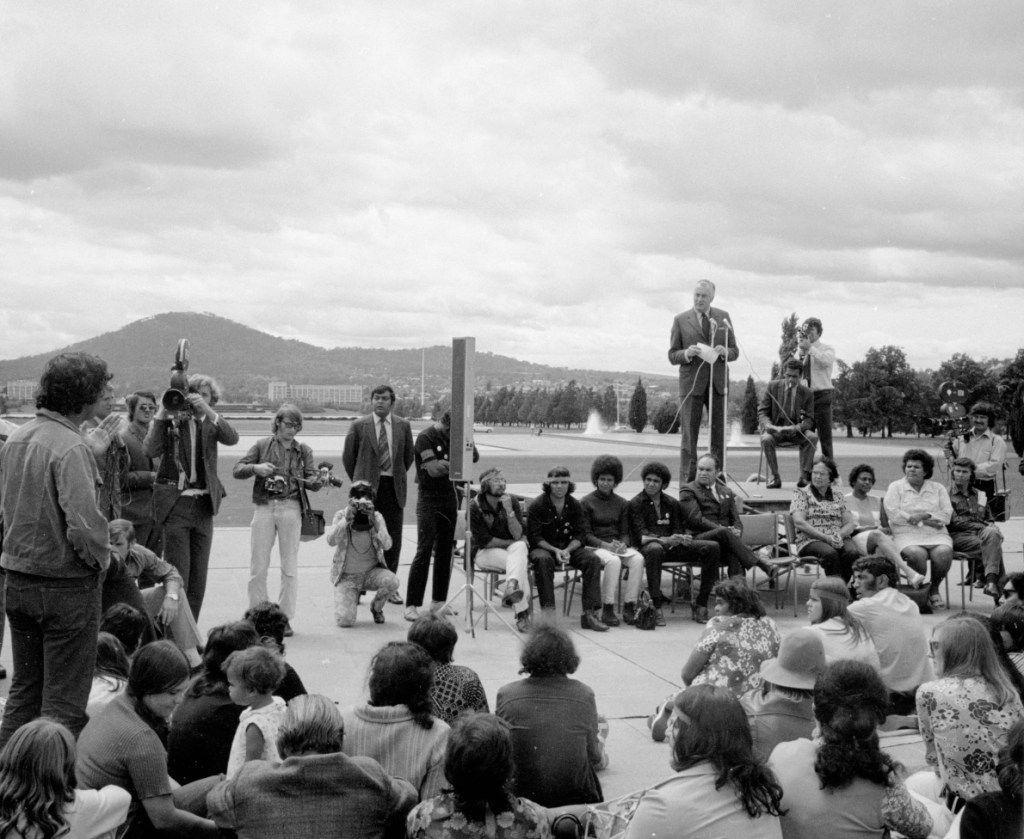
In 1972, four squatters established the Aboriginal Embassy underneath a single beach umbrella that had been plunged into the lawn outside Parliament House in Canberra. Although faces did change over time, the Embassy remains in place to this day.
In 1973, the Whitlam government provided funding to the Aboriginal Housing Company. The AHC purchased houses in Redfern and renovated them. As people moved in, The Block became a venue and destination for aboriginal families.
However, not everyone appreciated this new direction in which Australia was heading.
In 1975, the Australian Prime Minister was sacked. The likely reason being PM Whitlam’s refusal to sign off on a new lease relating to American use of the Pine Gap (NT) spy facility. The current lease, the one in place at the time, was one month away from expiring.
No doubt, the changes to the colonial project, which Whitlam implemented to the betterment of our society and culture, upset some people along the way.
Living within a segregated society causes both the oppressed and the oppressor to become sick. Those who are subject to domination are denied acceptance, opportunity, and justice. Those that have power over others cannot stave off the disease that comes from constantly hating upon a section of the local population.
Once Whitlam was ousted, establishment forces were able to return to the head of the Australian nation. The era of grand social change seemed to be over.
This was not the end of activism, however, and the squatting movement expanded and diversified, splitting squatting actions into protest and spectacle on the one hand, and direct action housing on the other.
Labour activism persisted and the Builders Labourers Federation led the way in innovative and creative class struggle. The BLF managed to rock the foundations of the establishment with a variety of tactics that included the Green Ban.
In sum, for just thirteen years of modern Australia’s 237-year history, a glimpse of what Australia truly is, and what Australia could genuinely transform itself into, became distinct and highly visible to the nation.
It remains a vision that motivated many, if not most, to strive to create a better society, without the need to tread upon others.
It was a monumental cultural transformation that has remained engraved upon the national consciousness. And it continues to represent something quite brilliant that was either forged throughout those unconventional years or otherwise was revealed to have always been present within the national spirit.
Either way, this valuable historical moment, this critical time of change and growth, these thirteen years of something else, belongs entirely to the Australian people.
It remains possible for Australians to repeat this experience of deep social transformation.

Photograph | State Library of New South Wales and the SEARCH Foundation
Further reading:
https://www.nma.gov.au/defining-moments/resources/indigenous-referendum
https://www.nma.gov.au/defining-moments/resources/whitlam-election
https://www.nma.gov.au/defining-moments/resources/aboriginal-tent-embassy
https://www.nma.gov.au/defining-moments/resources/whitlam-dismissal
Rocking the Foundations. Australian documentary on NSW Builders Labourers Federation.
Pilger, John. A Secret Country. 1992. See chapter: The Coup.
Acknowledgement:
State Library of New South Wales and the SEARCH Foundation | Tribune
Photograph | Item 680 | Call Number ON 161/680
Title | Tribune negatives including speakers at the Aboriginal Tent Embassy, 8 February 1972, and Wendy Bacon.
Permalink: https://collection.sl.nsw.gov.au/digital/RyzOlvldZ2Jw3

 Punk Human
Leave a comment