DARK CITY : CLASS WAR IN 1930s SYDNEY
by Keith Salter
This is a true story from Sydney’s dark past. It is the tale of a vicious and brutal class war. A war that was unjustly waged against ordinary Sydneysiders by a decadent and wealthy elite.
As the Great Depression unfolded throughout much of the 1930s, unemployment became widespread. Paying jobs became scarce and many personal incomes dwindled to zero. The ability to pay full rent or even part rent was seriously hampered by the years-long economic failure of capitalism.
The elite of Sydney protected themselves from the unfolding economic devastation by investing in income producing assets like residential property. This meant that the Sydney elite owned the homes of many working class people and charged them rent to reside within these properties.
However, the same local elite also owned the offices, shops, and factories, which in turn, were either downsized or shut down completely to curtail any further financial losses. These workers were left with neither job nor income. But that did not stop landlords from demanding the payment of rent.
The employment market ceased to be a market of any kind. Jobs could not be found because they simply no longer existed. Many unemployed people went without paid work for months at a time and some were unemployed for a year or more. In a situation such as this, the unwelcome spectre of eviction and homelessness soon appeared.


When eviction did occur, which was often enough during the 1930s, many different scenarios were forced onto those evicted. None of them were desirable.
Some went to live in cramped housing with family or friends, whilst others were directed to the many makeshift homeless encampments that had sprung up around Sydney. A few went into the bush and lived there, hunting and fishing to support themselves. Others simply walked the streets with their possessions in tow, hoping like hell that something favourable would appear before them.

Between February and May 1931 | The anti-eviction campaign began in earnest
THE ANTI-EVICTION COMMITTEE
However, history also indicates that many chose to resist these evictions. And, that this material resistance was not a disorganised rabble seeking handouts, but rather, an intelligent and sensitive reaction to a particular historical moment that was indeed devastating the lives of multitudes.
In Sydney during the 1930s, this noble work was undertaken by the Anti-Eviction Committee. Known affectionately as the “Anti’s,” the Anti-Eviction Committee organised against these shameful evictions, some of which displaced families with children from their homes and left them to sleep in the streets.
The Anti-Eviction Committee was highly organised, sufficiently motivated, and employed a variety of strategies and tactics. Their strong singular focus on resisting evictions during the financial turmoil of the Great Depression served to enhance and solidify their campaign for justice.
The strategies employed by the Anti-Eviction Committee included fighting evictions in the courts, fighting evictions by operating community centres where tenant’s rights were disclosed for no cost, fighting evictions by holding public meetings to inform about rights and current situations, and fighting evictions at the street level where it always counts most.
On the streets, the Anti-Eviction Committee was clearly an impressive organising force for the public good. The Anti’s would provide “house guards” in advance of eviction day to protect working class families from eviction, which if enacted, would likely be followed by many months of destitute living. The “house guards” would greet any landlord or proxy, any police officer, and any “men without coats” (often standover agents acting as removalists on eviction day). As you can imagine, the greeting was not a warm welcome.
If an eviction was in progress, the Anti-Eviction Committee would spring into action as if on a “live wire.” At quite short notice the Anti’s were often able to muster large numbers, often in their hundreds, to protest and defy any prospective eviction. If the “men without coats” had already emptied the targeted property of furniture, the Anti’s simply hauled each piece of furniture back into the property.
Things seemed to peak during 1931, when Sydney landlords persisted with demands for rental income, which of course could not be paid to them, as there was simply no money available.
Unperplexed and without compassion, some landlords and real estate agents sought to evict tenants in rental arrears. It was to spark a revolt by the working class.
Over three days and nights, from Wednesday 17th to Friday 19th of June 1931, three separate and intense battles were fought between police and the Anti-Eviction Committee. (Newspaper reports below).
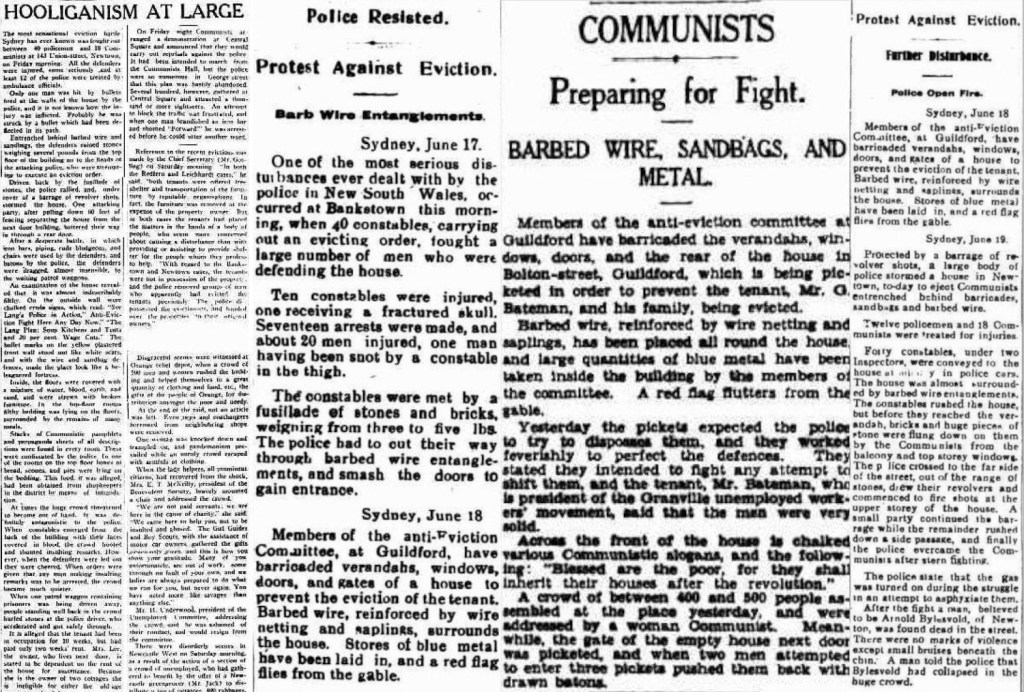
June 1931 | Active resistance to eviction organised by the Anti-Eviction Committee
A house slated for eviction in Bankstown was occupied by the Anti-Eviction Committee and barricades of sorts were installed. Walls of the property were made to bear slogans. A red flag fluttered atop the premises. Police action, after some great effort, succeeded in dislodging the occupants.
Not to be discouraged, the Anti-Eviction Committee shifted themselves to Guildford and reiterated their practical resistance strategy. Another tough battle ensued and yet another eviction occurred.
After being evicted from the property, the second in as many days, the Anti-Eviction Committee moved to a third location to support local people ensconced within a property situated in Newtown. The occupants gallantly resisted the eviction whilst a large crowd of supporters gathered in front of the terrace and heckled police as they stood about in the street.
Following the exciting battle at Newtown, and only after many occupants had escaped down a back alley, the police enforced the eviction in full. The house was made empty by police and secured to stop people from living in the property.
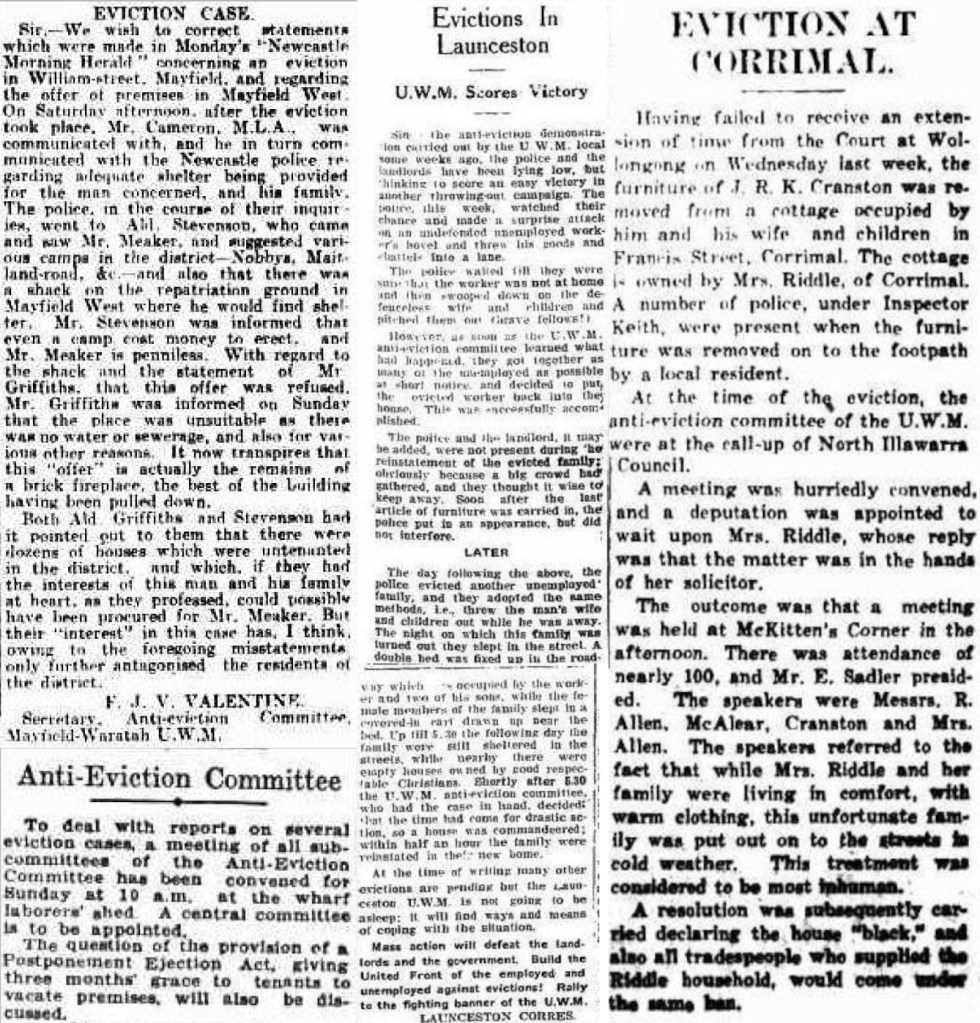
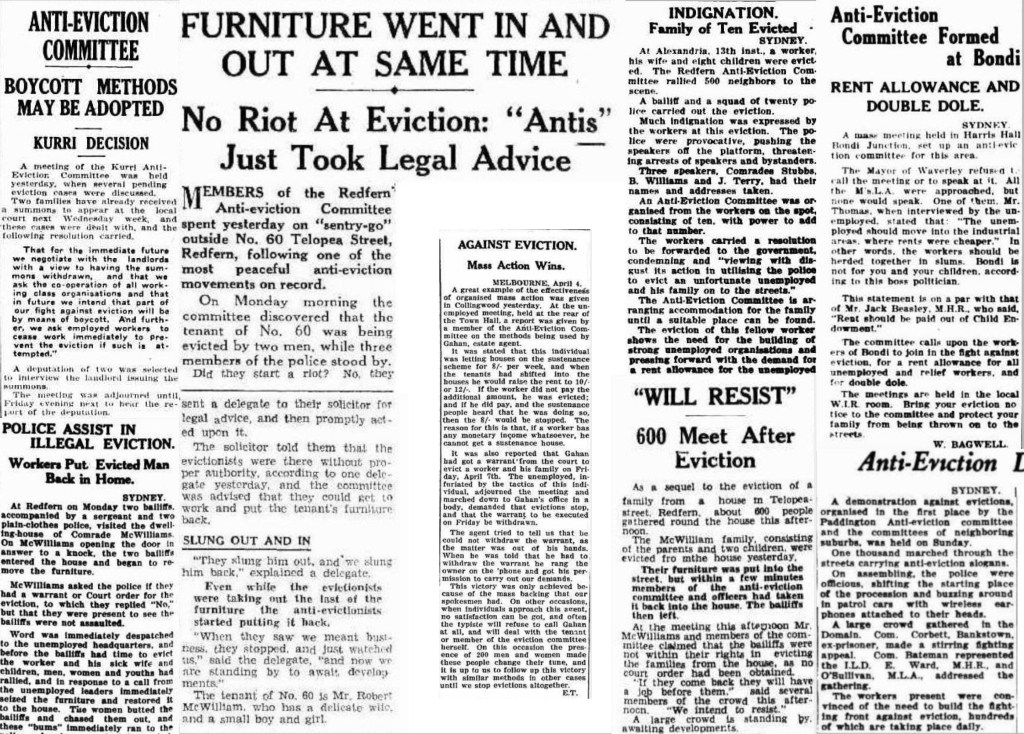
MORE THAN A MEME
The Anti-Eviction Committee had fought a fierce campaign against evictions during the winter of 1931. It was a demanding enterprise but also a worthwhile one. This highly organised and highly motivated outfit demonstrated to everyone with eyes and ears that the rules of the system are simply there to keep us in our respective places.
What the public actions of the Anti-Eviction Committee also manifested was the production and circulation of an ideal relevant to working class solidarity and mutual aid, and at a time of significant social hardship and distress.
Moreover, the steadfast work of the Anti-Eviction Committee can be reasonably compared to the common strategy of squatting, as evinced by the actions of Gerrard Winstanley during 1649, and which is based upon the principles of civil disobedience, non-compliance, and direct action.
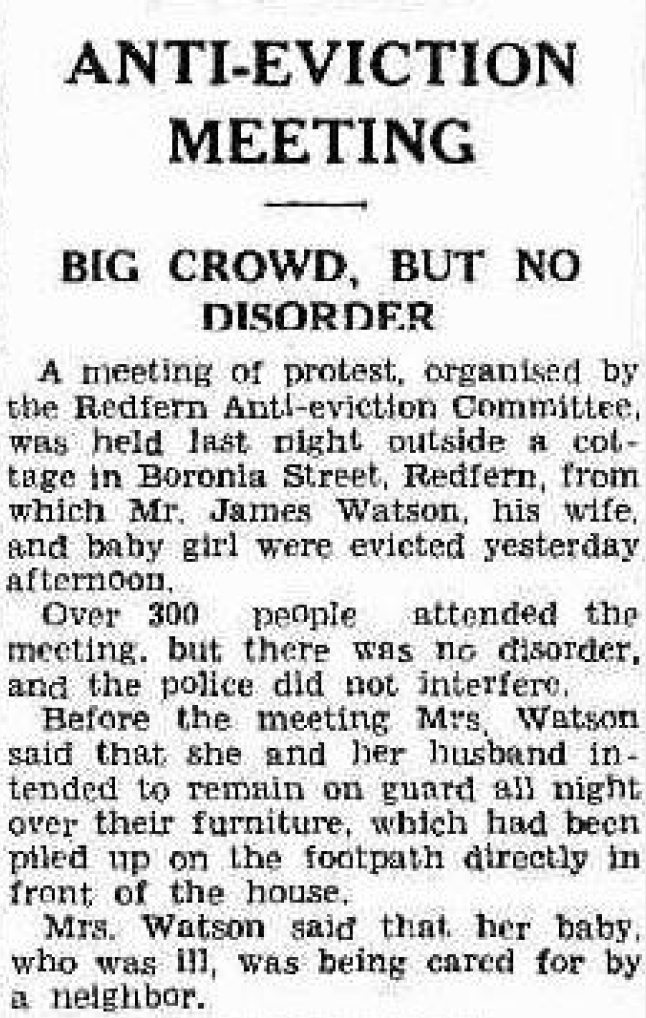
March 1934 | The Anti-Eviction Committee continues to operate
NOW
Finally, as financial collapse looms over the West, which includes Australia despite its position to the south, we should take a moment to remember those that came before us, that experienced sustained hardship and yet pulled through, and that resisted eviction and provided mutual aid to others in distress.
We should also bear in mind that although the faces and personalities of Sydney’s wealthy elite may have changed since the 1930s, the dirty practice of eviction and lockout persists. Expect it to expand and intensify as the national debt balloons, jobs disappear, and incomes shrink.


ACKNOWLEDGEMENTS
• Newspaper articles were retrieved using the Trove database.
 Punk Human
Leave a comment